3
Production workstations
Black Box I, II + III
Black Box I runs the operator stack: a chief technology agent for business development and strategy, the Rift Wars engineering, social, and web agents, the portfolio and personal-brand agents, a game-design agent, and the Omakase social-ops engine, all coordinated over a custom MCP message bus. Black Box II runs the creative and development cluster, its own CTO agent plus Unreal Engine, generative-art, and creator-economy agents, now bridged into the same comm hub over MCP. Black Box III is the mobile field unit: a single CTO agent that bridges back to Black Box I and II so the operator can keep building while away. Twelve agents across two workstations, one bridged cluster, one operator.
A controlled applied-R&D study, not a yield play. Aria V2 priced fair value deterministically against spot, volatility, and time-to-close using a proprietary engine, with no LLM in the loop. The output was the research, not a return.
Aria V2: a proprietary deterministic market-structure engine.
Built, validated, and now running as an ongoing paper-mode research program. The engine is pure deterministic math. It prices every bracket against a normal random-walk model built from live spot, realized minute-by-minute volatility, and time-to-close, then flags only where the order book has not yet repriced a move the market already made. Fast, liquid reference markets, evaluated end to end.
No LLM at decision time, by design. Language models drift: they reinterpret rules and inflate probabilities. The engine's signal is arithmetic, not interpretation: fair value minus quote, gated by hard caps. Sub-second decisions. Zero token cost. This is the proprietary core that carries forward to any future agent.
The architecture is drift-proof and reusable: deterministic code owns the logic, the model is a sandboxed function, external settlement is the only authority. WSL-native, fully self-hosted, ~$0 to run. The same discipline now underpins the business and marketing agents on the stack.
The mission was a research question, not a yield target: is there a repeatable, automatable edge for a small account, the little guy, in prediction markets? Aria answered it. That study is complete and published; the engine now runs on, paper only, as an ongoing automated market-research program across tokenized-asset markets.
Running an agent in production means operating it against a moving target. Third-party APIs change schemas, rate limits, and auth without notice; platforms quietly shift how friendly they are to AI agents, and a single policy or endpoint change can break or degrade how an agent behaves. So part of the work is constant: monitoring API and platform changes, catching the ones that would affect how agents operate, and adapting the integration before it costs a cycle. The output is the visible part. The maintenance discipline, watching the environment and keeping the agent alive through it, is the part most "AI agent" demos never reach.
The honest finding: there is no repeatable directional edge for a small account. Every strategy was a direction bet, roughly a coin flip after fees. The one apparent edge was a single lucky stretch that ran into a platform API change that wiped the account and never recurred.
So Aria pulled the actual numbers. The top of the profit leaderboard is not sharp forecasters: the top accounts had each traded 20,000 to 110,000 markets, one over 540,000. Nobody calls half a million outcomes by hand. They are automated market makers collecting the spread. Machines win the fast books (crypto, sports); humans only win the slow ones (politics). And 64% of retail posting their own results are underwater all-time, because the fee peaks at a 50/50 coin flip, the exact bet most retail makes.
The opening is not out-trading the market makers. It is the unbuilt retail-retention layer. The same week the research wrapped, Meta confirmed the thesis: per the NYT, Zuckerberg ordered a prediction-markets app ("Arena") that uses points and distribution, not real money. The next winner out-retains the user, it does not out-trade the book.
R&D I run personally, so the teams and clients I advise do not learn it the expensive way.
Eight AI agents coordinating through a custom MCP message bus: a chief technology agent for machine-wide strategy and build direction, the Rift Wars lead engineer, social, and web agents, a portfolio web agent, a personal-brand agent, a game-design agent, and the Omakase social-ops engine. Alongside them: the Aria research engine (paper mode, above), a Codex CLI failover layer, an interactive oracle (GodTerminal, paused), and a custom MCP control surface (Agent Comm Hub + BlackBox Console). Each agent runs isolated project context, persistent memory, and structured inter-agent handoffs. The patch-notes pipeline coordinates product, social, and web releases through a single command, auto-formatted by agent and hand-approved before deploy.
The second rig, a workstation-class GPU box built for local generative work, now bridged into the Black Box I comm hub over MCP. It runs its own four-agent cluster under its own CTO: Unreal Engine development, generative-art pipelines, and a productized creator-economy engine. Alongside the cluster sit a creator-persona pipeline, an in-development AI Life OS, and an interactive creative companion. Distinct from Black Box I's operator stack, coordinating cross-machine through a phased, audited bridge.
Black Box I runs the operator stack, chief technology agent, Rift Wars engineering, social, and web agents, the portfolio and brand agents, the MCP hub. Black Box II runs the bridged creative + dev cluster under its own CTO. Black Box III is the mobile field CTO that bridges back to both. Framework-agnostic by design. Best tool for the task, not a single vendor SDK. Local-first where it can be (ComfyUI, WSL), cloud where it has to be (Claude, GPT).
Framework-agnostic by design. Best tool for the task, not a single vendor SDK. Local-first where it can be (ComfyUI, WSL), cloud where it has to be (Claude, GPT).
Best tool for the task, not a single SDK. Claude for operator reasoning, GPT for image gen, ElizaOS for ELIZA-style agents, OpenClaw as the gateway.
No external cron or bash scripts touch money or production. Internal framework actions only, auditable, testable, and bounded by the agent's own constraints.
The proprietary engine runs a 6-gate validation system before any action: GoPlus, DexScreener, Honeypot.is, RPC checks, and a macro filter. Every gate must pass first. Other agents on the stack apply analogous discipline.
Most "multi-agent" setups are theoretical. The Agent Comm Hub MCP server is in daily production use across two bridged machines, register, send, broadcast, dispatch a sub-agent in its own project folder and get the result back.
Blackbox Console exists because checking a dozen-plus agents across two machines by ps aux is not a workflow. Single-pane-of-glass control surface for the running stack.
Patrick's own marketing playbooks and narrative systems compound into a reusable working asset that travels with him, independent of any single engagement.
 ▸ asset
Production-grade multiplayer card game shipped solo through AI-augmented development. 57,000 lines of game logic inside a 200,000-line full-stack TypeScript codebase, server-authoritative multiplayer, 6-tier minimax bot AI, 4,276 cards, full ranked ELO, social layer, economy. The Meta Machina universe it ships within drew a DroomDroom feature: "Solo Developer Leverages AI to Build AAA Game Universe."
Kling for video generation, MidJourney for visual development, ElevenLabs for voice direction, RunwayML for post. Full Meta Machina trailer produced solo with no studio budget, frame-by-frame direction, color, sound design, and edit.
 ▸ asset
Self-funded AI-assisted diagnostics, automated monitoring, remote management pipelines compressing team-scale infrastructure into a single-administrator model. The bottom-up adoption story: a single admin running 600 endpoints by treating AI as a force multiplier.
 ▸ asset
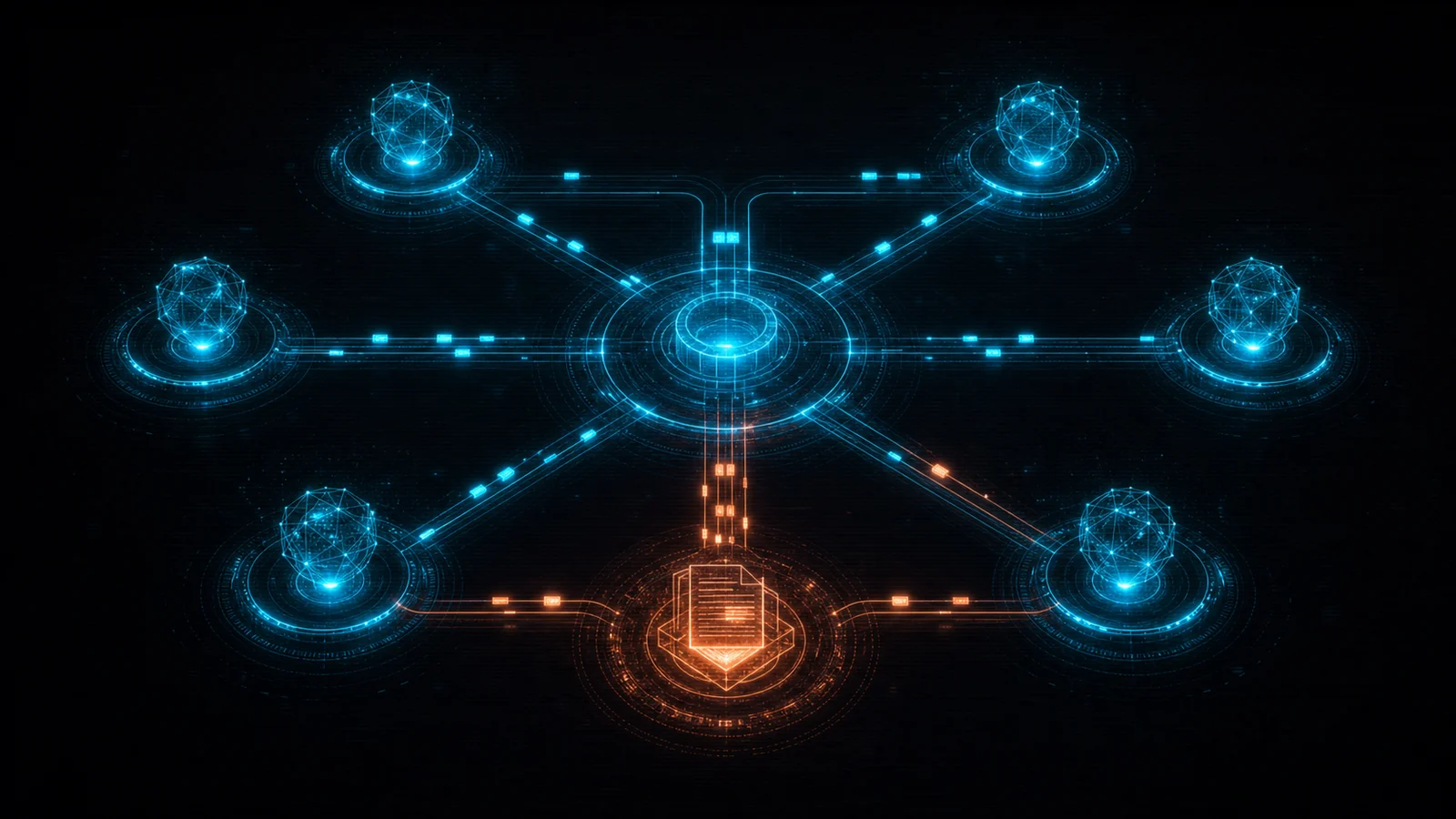
Inter-agent handoffs as first-class artifacts. AGENT-NOTES.md coordinates context across Rift Wars CTO, Social, and Web agents. Pattern documented and reusable across projects.
The discipline that distinguishes "uses AI" from "operates AI" shows up in the document layer. Below: the agent-infrastructure papers I authored, with sizes and dates. Full Syscoin dossier →
▸ Personality bible · Q4 2024 · 12+ MONTHS AHEAD
Full personality system for SuperDapp's AI agent, voice, tone, hashtag locks (#AIAgents #AITokens #CryptoAI), engagement-style rules per audience tier. Authored before the broader AI-agent crypto narrative (Virtuals, ai16z, GOAT) consolidated in late Q4 2024 / Q1 2025.
"AI is the evolution of intelligence. Blockchain is the evolution of trust. Together, they rewrite everything."
▸ Technical proposal · 2025 · 225 KB
Fully-specified architecture for a trustless engagement-bounty agent. Verifies X / Instagram / TikTok / image proof. On-chain payouts. Dedup-guards. RBAC (Owner / Admin / User / Auditor). Rate limits, spend caps, tamper-evident audit logs.
Deployable infrastructure, not vapor. Demonstrates full-stack capability: product design to technical spec to risk/compliance reasoning under one author.
"The gap is not visibility. The gap is that the market has not found a compelling reason to use what has been built. This is a product-market fit problem, not a marketing problem."
AI Strategy Brief v7 · Q1 2026 · willing to write the hard diagnosis
openclaw highlighted, Patrick's own framework.